Wednesday, 24 October 2012

The Chemistry of Petroleum

Petroleum Chemistry is made of a mixture of different hydrocarbons. The most prolific hydrocarbons found in the chemistry of petroleum are alkanes, these are also sometimes knows as branched or linear hydrocarbons. More you can find out here.

Courtesy: http://www.petroleum.co.uk

Tuesday, 23 October 2012

Phase Rules

The system is simply the matter that we are studying, collected in one place and with definite boundaries. Our systems will generally not exchange matter with the surroundings, and so will be called closed. They may be isolated and not exchange energy with the environment, or sometimes in contact with a thermal reservoir of temperature T.  More details here.
Courtesy: J. B. Calvert, http://mysite.du.edu

Monday, 22 October 2012

Ester Chemistry

Esters are derived from carboxylic acids. A carboxylic acid contains the -COOH group, and in an ester the hydrogen in this group is replaced by a hydrocarbon group of some kind. This could be an alkyl group like methyl or ethyl, or one containing a benzene ring like phenyl. Click here for more details.
Courtesy: Jim Clark, http://www.chemguide.co.uk 

Sunday, 21 October 2012

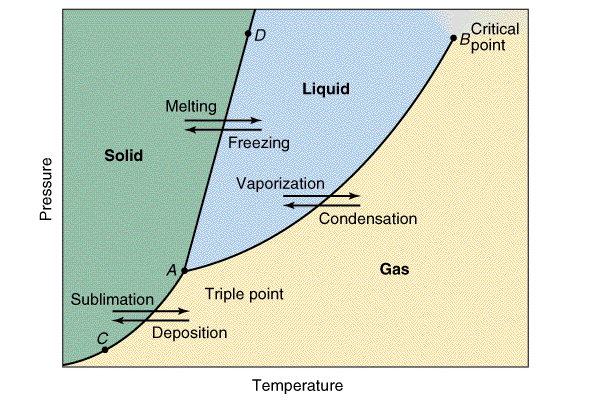
Phases and Equilibrium

The phases of matter represent classes of the type of molecular motion found at different temperatures.  The 'motion' of the maolecules is described by the position and momenta of the atomic nuclei. The position of the molecule as a whole is derived from the center of mass of the atoms that compose it  The molecules undergo classical (not quantum mechanical) motion, either harmonically bound (solid), chaotically quasi-bound (liquid) or unbound (gas). More here.

Courtesy: PJ Brucat, University of Florida

Saturday, 20 October 2012

Sir James Chadwick - Birthday

James Chadwick was born on October 20, 1891, in Cheshire, England. He graduated from Manchester University's Honours School of Physics in 1911 and spent the next two years working on various radioactivity problems in the Physical Laboratory in Manchester, earning a M.Sc. degree in 1913 as well as the 1851 Exhibition Scholarship, which allowed him to continue his research and move to Berlin to work with Professor Hans Geiger. More here.
Sir James Chadwick
Courtesy: http://www.atomicarchive.com

Ozone Affects Forest Watersheds

U.S. Forest Service and Oak Ridge National Laboratory (ORNL) scientists have found that rising levels of ozone, a greenhouse gas, may amplify the impacts of higher temperatures and reduce streamflow from forests to rivers, streams, and other water bodies. For more click here.
Small stream in Maryland, U.S. (Credit: Copyright Michele Hogan)
Courtesy:  Ge Sun, Eastern Threat Center research hydrologist

Friday, 19 October 2012

Rise of the Molecular Machines

Mastering and mimicking how molecular machines work has been a fascinating adventure for chemists, and one in which their creativity has been unleashed. For more click here.


Courtesy: Josh Howgego, www.rsc.org/eic
Message from Bhagavath Geetha
  • Do not get over excited over happiness and do not get over depressed over sorrow.
  • Do not get over bonded with anyone and anybody because it can lead to problems and sorrow.
  • Never think that my duty is the topmost or lowermost. Every duty is respectful. The responsibility undertaken or given as per the position is the noblest duty.
  • Elevate yourselves, family, society and nation and never denigrate yourselves, family, society and nation.
  • We are our own closest relatives and if not properly utilised we will become our closest enemies.
  • There are possibilities of success and failure in any endeavour. One cannot assure success always.
  • Death is inevitable for everyone in this world. In any endeavour at the maximum an individual may die.
  • People may say good and also they may say bad. Approach them with stabilised mind.
  • Take anything after scientifically, logically and rationally analysing them.
  • Perform your duty, responsibility and accept the privileges eligible for you.
  • First change ourselves and then try to change others.
  • We are all instruments /tools in the hands of the nature for performing the duty. So do not think that I am doing the duty. Think that I am an instrument to do the duty.
  • Results of action may not be sweet always. Accept what ever may be the result.
  • Follow the path of great scholars who guided the world. Listen their messages.
  • Results and rewards will come and go but stick to your duty with devotion, dedication and sincerity.